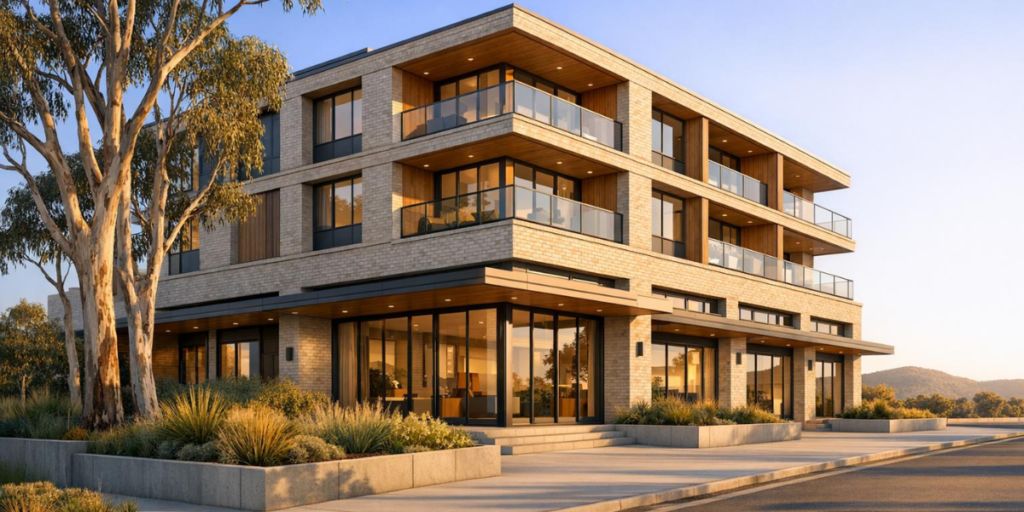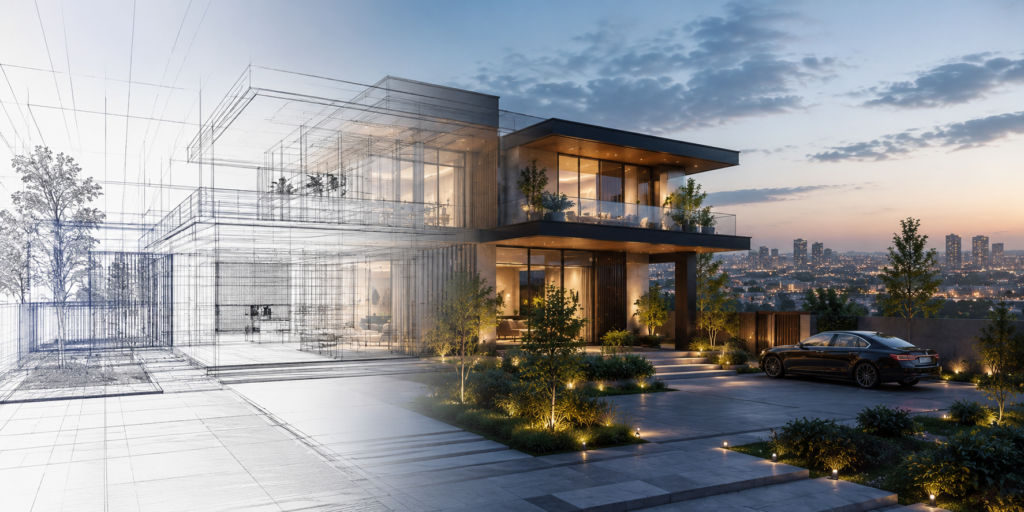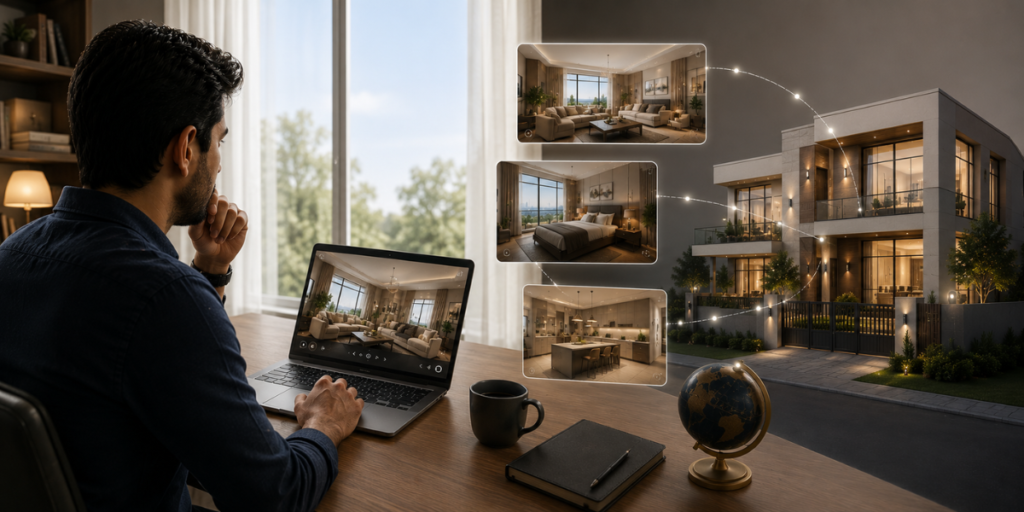
You have probably seen it happen. A developer shares a render of a new project, and within seconds someone in the comments asks whether it is a real photo. That is the goal.
You have probably also seen the opposite: renders that look like an old video game, with shiny floors, floating furniture and a sky that feels painted on.
The difference is rarely the software. Most studios use similar tools. It comes down to how well the artist handles light, materials and the small details. After years as a 3D architectural visualization company in Pakistan, here is what we have learned makes a render look real.
1. Lighting does most of the work
If the lighting is wrong, nothing else will save the image.
Real light behaves in specific ways. Sunlight is warm in the morning and evening and cooler at midday. It bounces off walls and floors, so shadows are never pure black. Indoors, light fades as it moves away from a window.
Good 3D exterior rendering services copy all of this. It uses a real sun position for the project’s actual location and orientation, so a building in Karachi gets Karachi light, not a generic studio setup. That is also why dusk shots are so popular: warm interior lights against a soft blue sky look natural and flattering.
2. Materials need imperfections
In the real world, nothing is perfectly clean or perfectly flat.
- Concrete has small stains and colour variation
- Wood grain changes from plank to plank
- Marble veins never repeat
- Glass shows reflections, a slight tint and sometimes smudges
- Fabric creases, and cushions sag a little
Fake-looking renders usually have materials that are too perfect. Every tile is identical and every reflection is mirror-sharp. Small imperfections are what make the eye believe it. This matters even more in interior design rendering, where buyers look closely at every surface.
3. Scale and proportion
This one is easy to miss, but buyers feel it instantly. If a door is slightly too short, a sofa too deep or a counter at the wrong height, the room feels off even if the viewer cannot say why. Believable renders follow real-world dimensions, down to skirting boards and switch heights.
4. The camera matters
Real photographers do not shoot buildings from random angles. They use eye-level heights, straight vertical lines and lenses that do not distort the space. Many weak renders use extreme wide angles to make rooms look bigger, which only makes them look stretched. A believable camera is one a real photographer could have used.
5. Life in the scene
An empty building looks like a model. Add a few people walking past, cars on the road, a coffee cup on the counter and a book left open on the sofa, and suddenly it feels like a place. The key is restraint. Too many props make a scene feel staged.
6. The surroundings
A tower floating in an empty field will not convince anyone in Pakistan, because buyers know the area. A strong render places the project in its real context: the actual road, the neighbouring buildings, the sea view or the park nearby. This also builds trust, because buyers can see the developer is not hiding anything about the location.
7. Interiors need to feel lived in
Indoors, the biggest giveaway is a home styled like a hotel lobby. Real homes have a lamp switched on, a throw on the sofa and a rug that is not perfectly centred. Good interior renders find the balance between clean and lived-in.
8. Motion raises the bar
Everything above gets harder in video. Light has to stay consistent as the camera moves, reflections have to shift naturally, and trees and water have to move believably. That is why quality architectural 3D animation services take longer to produce. Done well, though, animation is the most convincing way to sell a project before it is built.
Why this matters for sales
Photorealism is not about showing off. It builds trust. When buyers believe the image, they believe the project. When something looks off, they start doubting the developer too, often without realising why.
A quick checklist before you approve a render
- Does the light belong to a real time of day?
- Are the shadows soft where they should be?
- Do the materials have some variation?
- Could a real photographer have stood here?
- Does it look like a place, or a set?
If any answer is no, it is worth another round.
Final thought
Realism lives in the details most people never consciously notice. That is what makes it hard, and that is why it works.
Pixarch has over ten years of experience in exterior and interior renders, walkthroughs and animation. If you want visuals that make people ask whether they are looking at a photo, we would love to work on your next project.